

Most locker orders are planned around headcount, color, and budget. Accessibility tends to arrive late, usually when an architect or inspector asks how many ADA compliant lockers the plan includes. By then the layout is fixed, and any change costs time and money. This post takes a simpler route: count first, measure second, place third.
You will find the exact scoping rule, worked examples with real arithmetic, and the reach, hardware, and bench numbers that decide whether a locker passes. Lockers Unlimited has supplied storage to schools, gyms, and workplaces since 1992, and these same planning questions come up on nearly every project.
The rule that drives your order is section 225.2.1 of the 2010 ADA Standards for Accessible Design. Where lockers are provided, at least 5 percent, but no fewer than one of each type, must comply with section 811. Two phrases in that sentence deserve attention.
The first is “each type.” State code guidance gives full-size lockers, half-size lockers, and lockers made for sports equipment as examples of different types, so a mixed order needs accessible units in every category. The second is “no fewer than one.” A small group of lockers still needs one accessible unit, even when 5 percent works out to less than a whole locker.
Locker rooms carry a separate rule. Where dressing, fitting, or locker rooms are provided, at least 5 percent, but no fewer than one, of each type of use in each cluster must comply with section 803. Your architect handles the room layout, and you handle the lockers inside it.
Say a fitness center plans 152 lockers across four types. Apply the 5 percent rule to each type, then apply the minimum of one.
Look at the team lockers row. Twelve lockers produce 0.6 of a locker, but the minimum of one lifts it to a full unit. A flat 5 percent of all 152 lockers gives 7.6, which lands near the same total here, but counting by type is what protects you because it guarantees every category has an accessible option.
Now a school. It orders 300 hallway lockers and 30 staff lockers. Five percent of 300 is 15. Five percent of 30 is 1.5, so plan for 2. That makes 17 accessible lockers in total. When a result lands on a fraction, plan to round up and confirm the rounding with your code official.
Write each result into your order as its own line, such as four accessible full size lockers, so the quantities survive from quote to delivery. A one-line note on the purchase order costs nothing and prevents the common surprise of accessible units arriving as standard ones.
Reach range is where most lockers pass or fail. The 2010 Standards set unobstructed forward reach and side reach at 48 inches maximum and 15 inches minimum above the finished floor. For a locker, the shelf, coat hooks, and lock all need to sit inside that window. One manufacturer’s ADA guidelines advise that on single tier lockers, the shelf and hooks sit no higher than 48 inches.
Base height changes the math. A metal locker on legs can sit up to 6 inches above the floor, while one without legs sits at the floor. Take a locker on 6 inch legs. Subtract the leg height from both limits and the shelf must sit between 9 and 42 inches above the bottom of the locker body, ignoring panel thickness. With no legs, the same window runs from 15 to 48 inches. We offer standard and raised bases, so confirm the base before you lock in shelf positions.
Ask your supplier for published shelf heights by model. Many single, double, and triple tier lockers can meet reach range once a shelf is fixed at the right height, but the numbers differ by manufacturer, so get them in writing.
A locker can sit at the perfect height and still fail because of its lock. Accessible hardware has to work without tight grasping, pinching, or twisting, and it has to sit inside that same 15 to 48 inch window. Small key-operated padlocks are the usual troublemaker. Push button and lever styles are easier for people with limited grip. Placement matters as well. A lock mounted above 48 inches on a tall single-tier door is out of reach no matter how easily it turns.
Our locker accessories include padlocks, built-in combination locks, electronic locks with keypad or RFID access, and key locks. Whichever you choose, ask how much effort the lock needs to open and where the control sits on the door. If you mix lock types across a facility, give the easiest ones to the accessible lockers first.
Reach range gets the attention, but clear floor space matters just as much. A wheelchair user needs room to approach the locker, typically a 30 by 48 inch clear area, plus room for the door to swing. In one public facility review, evaluators recommended 60 inches of turning space in front of accessible lockers. Our guide to locker room dimensions covers aisle widths and room layout, so use it alongside this count.
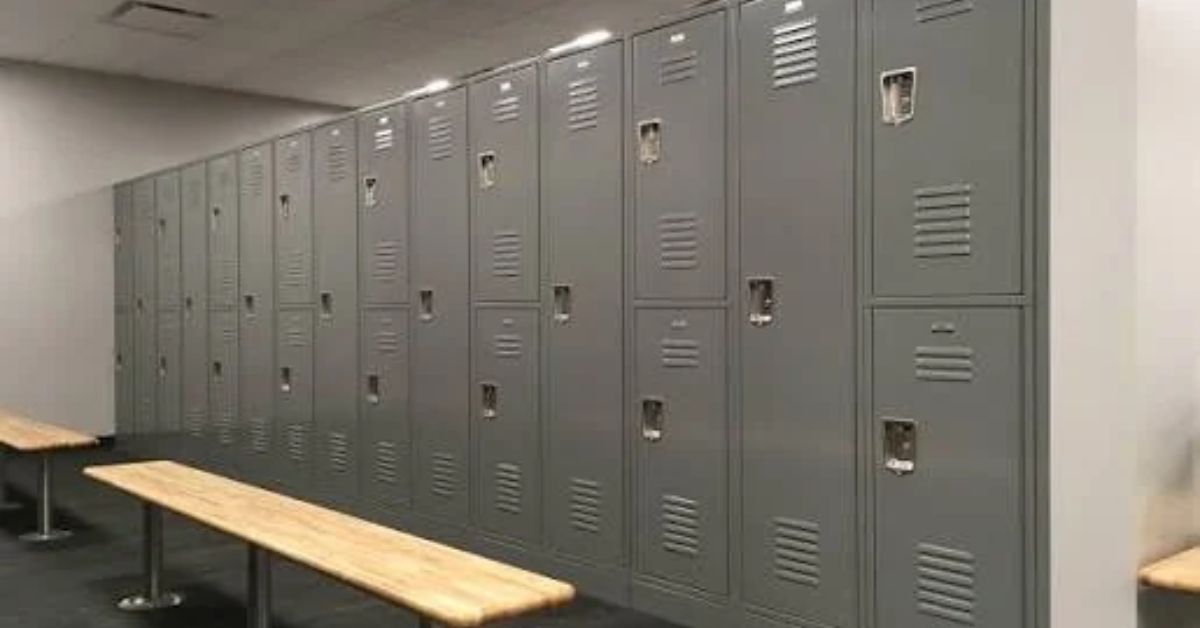
Accessible locker rooms also need a bench, and benches have their own numbers. An ADA locker bench should be at least 42 inches long, 20 to 24 inches deep, and 17 to 19 inches high, with back support. In wet areas, the surface should be slip-resistant and shed water. The bench rules apply to new construction and to alterations made after March 15, 2012. For material choices, see our advice on the best locker room benches. Our benches come in wood, laminate, and plastic, so ask which surface suits your room.

These errors show up again and again. Check your plan against each one before you order.
A short list of questions saves long phone calls later. Put these to any supplier, including us.
You do not always need new lockers. Start with a tape measure. Record the height from the finished floor to each shelf, hook, and lock, then mark every compartment that falls outside the 15 to 48 inch window. That short audit shows whether a few new shelves will do or a full bank needs replacing. Manufacturers note that existing lockers can often be modified by adding or relocating shelves to meet forward and side reach, as long as the hardware and floor clearance also work. If your project involves replacing a worn bank, our installation and demolition services can remove the old units and install the new ones.
Share your locker types, quantities, and floor plan, and our team will help you work through the count and shelf placement before you order. Request a free quote, and we will take it from there.
1. What makes a locker ADA compliant?
Shelves, hooks, and hardware sit between 15 and 48 inches above the floor, operate without tight grasping or twisting, and clear floor space lets a wheelchair user approach the locker.
2. How many ADA compliant lockers do I need?
The 2010 ADA Standards require at least 5 percent of lockers, and no fewer than one of each type, to be accessible. Confirm rounding with your code official.
3. Can existing lockers be made ADA compliant?
Often yes. Adding or relocating shelves can bring reach into range, depending on the model. Check manufacturer guidance first, because locks and floor clearance matter too.
4. What are the ADA locker bench requirements?
Benches in accessible locker rooms should be at least 42 inches long, 20 to 24 inches deep, and 17 to 19 inches high, with back support.
5. What kind of lock is best for accessible lockers?
Choose locks that operate without tight grasping, pinching, or twisting, such as push button or lever styles, and keep the hardware inside the 15 to 48 inch reach range.